
Setting the record straight.

Glendale Power Needs and Costs Fact Sheet


Some Glendale City Council candidates are advocating for running the gas-burning engines at the Grayson Power Center at a higher duty cycle (more hours per year). They claim that Glendale can sell this excess fossil fuel energy to neighboring cities in order to lower our utility rates—an ill-conceived and dangerous idea.

Despite their claims, this policy would:

1. NOT provide salable power and therefore NOT lower utility rates.
  • Glendale will be using it: Other cities will only want to buy power at peak times (hot summer afternoons/evenings), when Glendale will already be using it.
  • At non-peak times, other utilities won’t want it: For demand outside of peak times, utilities want to buy clean energy. They pay a premium for clean energy credits, but very little for dirty gas energy.
  • On top of that, GWP can’t sell it: Grayson does not now have access to the same-day and day-ahead markets (which are the mechanism for selling power) and will not for a couple of years.
2. NOT increase peak power (the maximum amount of power Grayson can produce at any moment)
  • When the city needs to run all gas units at Grayson longer due to need (high heat days), it already can — and at 100% capacity.
3. Increase local and regional air pollution
  • Especially the Pelanconi, Riverside Rancho and Grand Central neighborhoods that are within one mile of the Grayson gas engines, are already in the 100th percentile for Pollution Burden and are home to tens of thousands of residents and several local child care centers and elementary schools.
4. Increase health risks, such as cancer and asthma
5. Require Glendale to spend money on more expensive emission reduction credits
  •  Glendale will already need to buy expensive emission (pollution) reduction credits for both nitrous oxides and volatile organics for the current 14% duty cycle.
6. Require a permit (and therefore even more costs)
  • Glendale would have to get a permit from the South Coast Air Quality Management District (SCAQMD).
6. Glendale does not need to produce more fossil fuel energy.
  • Glendale has plenty of power (imported power + Grayson Unit 9 + some local solar) most of the time. Much of the imported power is renewable and/or carbon-free.
  • 3 new gas Internal Combustion Engines (ICE) and a new carbon-free 75 MW (300 MWh) battery are replacing obsolete, polluting equipment and will both provide peak power for hot summer afternoons and early evenings. GWP is working to get both assets online by this summer (2026) and continues to make progress on utility-owned local solar for local clean energy and resilience.
  • The Grayson repowering and current 14% duty cycle will already provide peak power for when demand is at its highest. Grayson can be operated more than 14% on a given day if demand requires it. It just can’t average more than 14% duty cycle over the course of a year (1120 hours).
  • In addition, Unit 9 (the existing and largest gas unit) has been refurbished and is being operated when needed, without limitations.
  • GWP’s ICE engines are awaiting permits and completion of installation to begin usage, and the zero-emission 75 MW Battery Energy System is being installed.
  • The battery will be charged with local solar and/or lower cost off-peak energy.
In summation, the idea that Glendale would buy expensive permits and purchase expensive pollution reduction credits (from cities that are producing extra clean energy) so that we can pollute our OWN neighborhoods (especially the Rancho and Pelanconi and adjacent neighborhoods), to sell dirty energy into a market that we don’t currently have access to and that is not interested in buying it at the times we’d want to sell it, is not only immoral, it is likely a money-losing scenario.

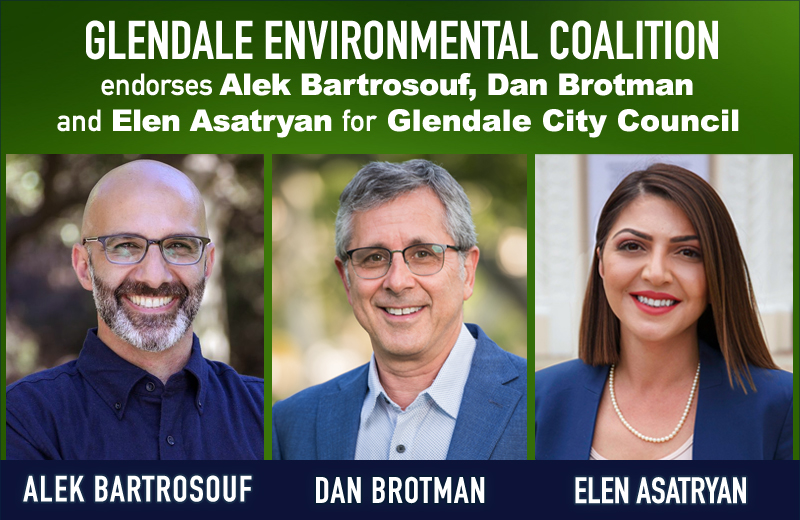
Vote for Dan Brotman, Alek Bartrosouf & Elen Asatryan

Candidates who will work to PREVENT pollution & climate impacts!
CONTEXT: Why did Glendale have to tear down and build a new energy center to begin with? What are we paying for?

The South Coast Air Quality Management District (SCAQMD) told Glendale that it was no longer allowed to run much of the old gas equipment at Grayson due to the high air pollution and the health risks. Glendale has removed all the old equipment except for Unit 9, which was upgraded and is again operational at 48 MW. Glendale is now installing the 3 new, less-polluting gas engines (total peak power of 56 MW) and a carbon-free emission battery (75 MW/300 MWh) and is scheduled to have it all online this summer. GWP is also investing in local solar to supply local clean energy and help fill the batteries, and is building a biogas facility to use the methane produced by the Scholl landfill.

Are you concerned about localized blackouts?

As far as we know, blackouts in Glendale have been exclusively caused by equipment failures or shedding load to avoid equipment failures caused by over heating, not supply issues. GWP is investing in needed upgrades to its local delivery infrastructure, including its distribution lines, so that, as our city turns from the gas pump to the EV charger, those lines can carry bigger loads more efficiently by being converted from 4kV distribution lines to 12kV. They are upgrading infrastructure to better handle the higher heat that the climate crisis is now delivering…those hot nights that do not cool off for days in a row. Those are what cause power outages here in Glendale (and mylar balloons and squirrels!)

California has a 100% Clean Energy by 2045 mandate.

With community advocacy and City Council direction, GWP made investments that limited its fossil fuel investments and also focused on assets that will be legally allowed to operate indefinitely, such as our large battery energy storage system. The alternate choice was putting a huge amount of money into a fossil fuel power plant that would cost increasing amounts of dollars to run and eventually become a stranded asset if it were not converted to hydrogen, which is in early stages of development.

A more affordable project:

According to the 2019 Integrated Resource Planning document from GWP, the original “all gas” project was projected to cost $174 Million MORE than the alternative of gas peaker units + 75 MW battery + local solar and other clean energy programs that GWP ultimately adopted (note that instead of 5 gas peaker units totalling 93 MW referred to in this plan, Council adopted a plan with 3 gas peaker units, totaling 54 MW). It was projected that this cleaner alternative project would save ratepayers 20% over the original 2015 all-gas project proposal.

GEC supports a resilient and reliable clean energy future that reduces local pollution, increases local resiliency, reduces long term costs and addresses the climate action that a livable future demands. We thank the City leaders that understood the importance of making the right kinds of investments to power our future.