August 4, 2025
Update on the Eland Solar & Battery Project
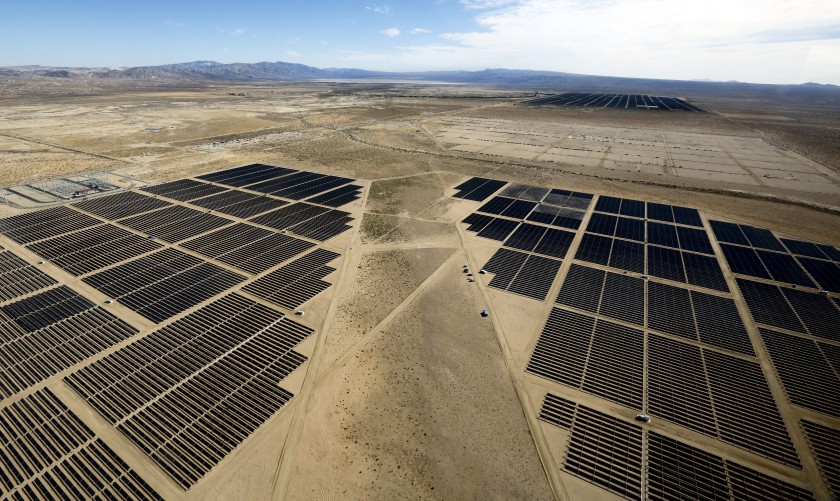
This May, Los Angeles Times’ Climate reporter, Sammy Roth, featured the Eland Solar & Battery Project on his podcast, “Inside L.A.’s Solar Megaproject“. Eland is the largest solar and battery storage facility built for Los Angeles to date. He toured the behemoth, 758 MW solar, 300 MW / 1,200 MWh storage facility which sits on 4600 acres near Mojave in Kern County, alongside the CEO of LADWP. They discussed the history of the project, the site and equipment, the low cost power it will provide at peak times of day, LA’s commitment to reaching 98% Clean Energy by 2030 and 100% Clean Energy by 2035, how LA is doing and what they will be pursuing to reach those targets. Sammy also covered these topics in his December, 2024 Boiling Point Newsletter.
Great conversation! But what does it have to do with Glendale?
GWP got in early on Eland negotiations, and owns 12.5% of the project! This equates to 25 MW of Solar / 75 MWh of battery storage, delivering up to 18.75 MW per hour of clean energy over a four hour period after the sun sets. Deliveries can be made during peak energy demand when it is often the most needed and when resources are most expensive. Glendale has limited access to transmission for electricity resources outside the Los Angeles basin, so the fact that this project included 25 MW of transmit capacity through an Open Access Transmission Tariff with LADWP (according to Glendale’s 2024 Integrated Resource Plan) was an important plus.
The Eland project set a record for the cheapest solar power and battery energy storage in the United States when contracts were signed in 2019. “The combined solar power and energy storage is priced at 3.3 cents per kilowatt-hour — a record low for this type of contract, city officials and independent experts say, and cheaper than electricity from natural gas.” (LA Times) GWP made a very smart move, getting in early with a 25-year Power Purchase Agreement, contracting peak power supply at record low cost. “Even today,'” says GWP General Manager Scott Melon,” I believe it is still some of the least expensive solar+storage resourced energy available.”
Phase 1 of the Eland project came on line in late 2024, approximately one year later than initially anticipated, due to Covid-related delays. According to Mr. Melon, GWP received test power May 20, 2024, with commercial operations commencing on November 27, 2024. Deliveries were initially less than anticipated, with Glendale receiving on average 12 MW. This grew to approximately 17 MW in February 2025 before the project was temporarily de-energized in April by Kern County, due to the developers having issues with flood permits. According to Mr. Melon, “the plant eventually came back online on May 7th, and it’s been supplying energy steadily ever since.”
How does Eland fit into Glendale’s overall energy planning?
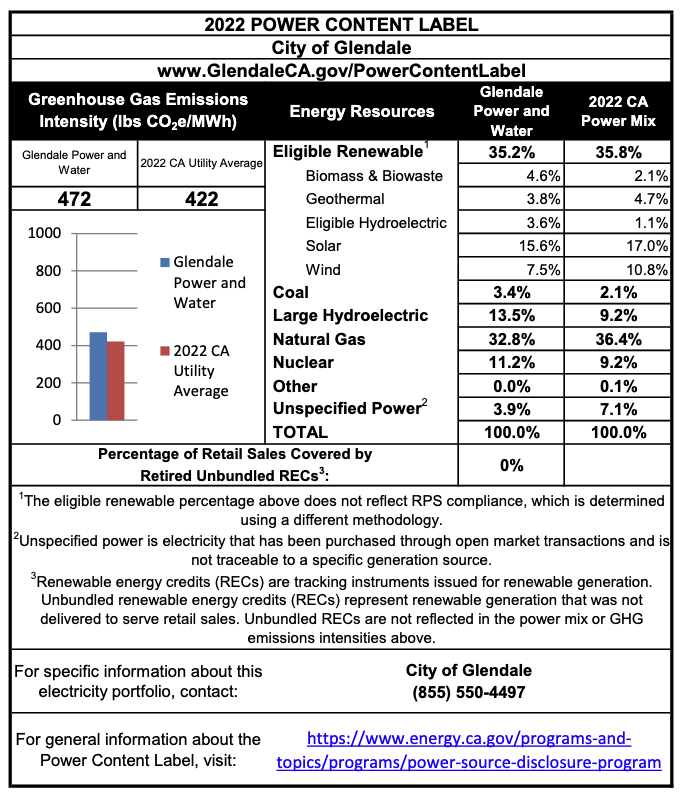
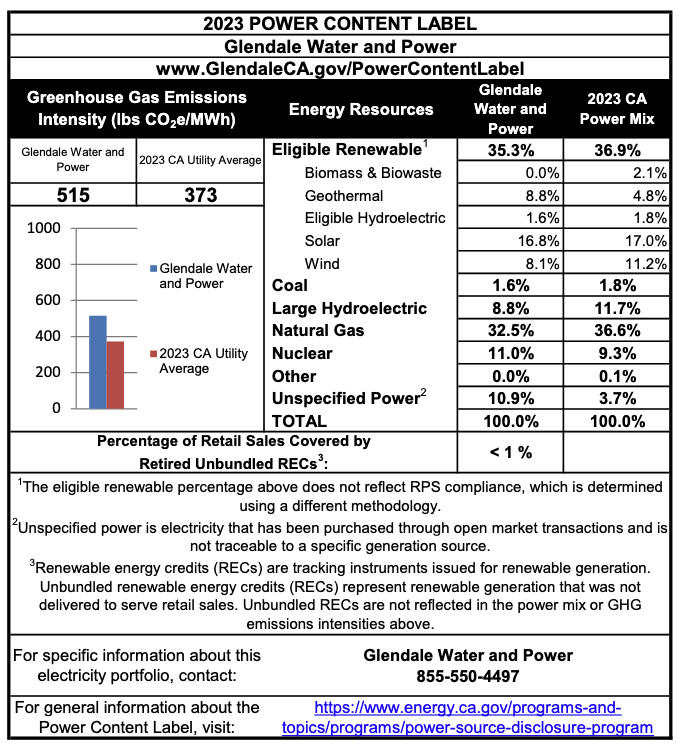
GWP has a council directed goal to achieve 100% Clean Energy by 2035 which is now adopted in GWP’s 2024 Integrated Resource Plan (IRP), the 20-years ahead planning document utilities are required to submit to the California Energy Commission every five years. In addition to the IRP, our utility is legally bound to provide annual “Power Content Labels” which chart our clean energy progress. The RPS program administered by the Public Utilities Commission requires each retail seller to procure eligible renewable energy resources so that the amount of electricity generated from eligible renewable resources equals an average of 33 percent of retail sales by December 31, 2020 and 60% by 2030. (Note: biomass & biowaste, considered “eligible renewables”, emit carbon.) Carbon-free resources include solar and wind, small hydroelectric and geothermal.
So, how are we doing?
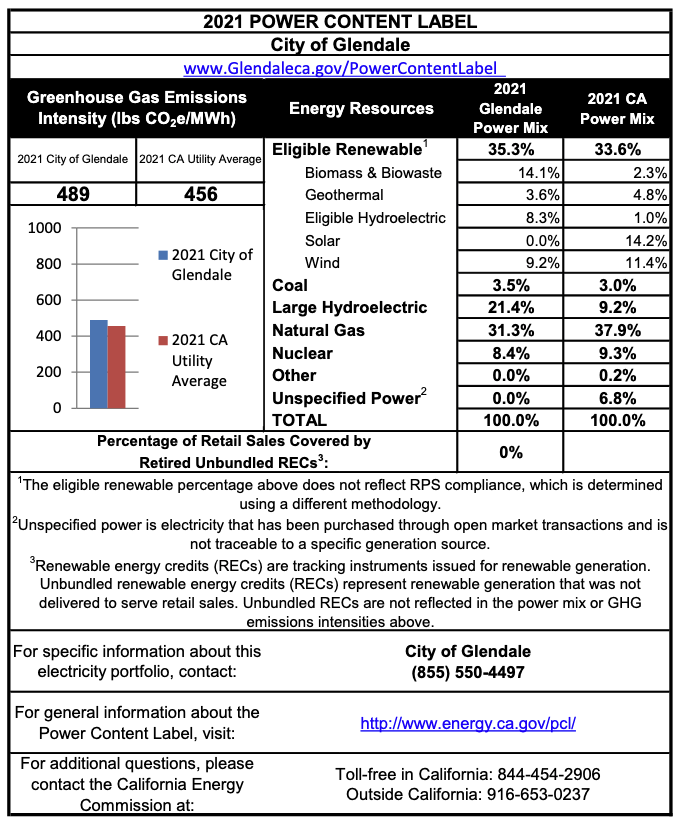
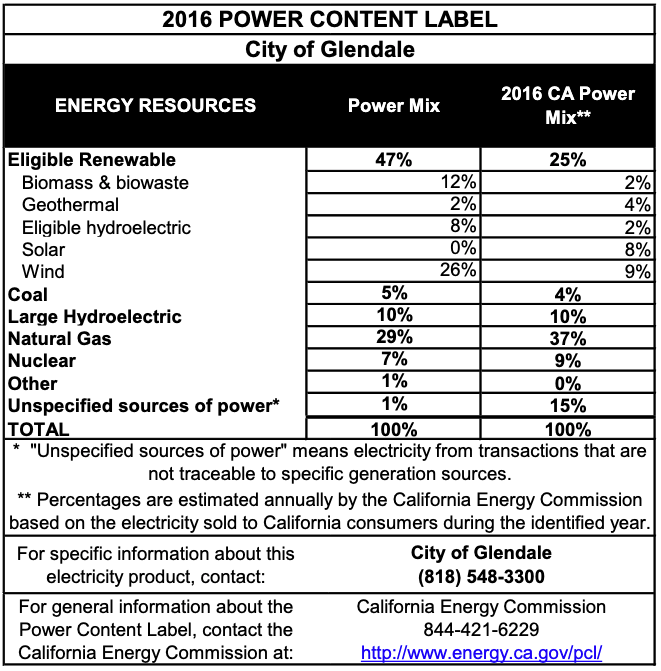
The latest Power Content Label indicates Glendale’s energy mix was 35.3% Eligible Renewables in 2023. This figure has not moved very much in the past several years, but is expected to take a leap forward with the Eland Project. Eligible Renewables were 20% in 2014, 22% in 2015, 25% in 2016, 29% in 2017, 31% in 2018, 32% in 2019, 33% in 2020 (just achieving the target goal), 35.30% in 2021, 35.20% in 2022, 35.30% in 2023. However, there has been a noted increase in solar from 0% in 2010 to 16.8% today (with one outlier year 2021 at 0%.) Eland should greatly boost those solar numbers. Scott Melon predicts improvements to Glendale’s Power Content Label next year. “GWP expects the Eland Project to provide an improvement to our 2025 Power Content Label of between 5-7%. These are significant strides in meeting our renewable obligations and our City Council’s zero-carbon goals.”
2022 Power Content Label
2021 Power Content Label
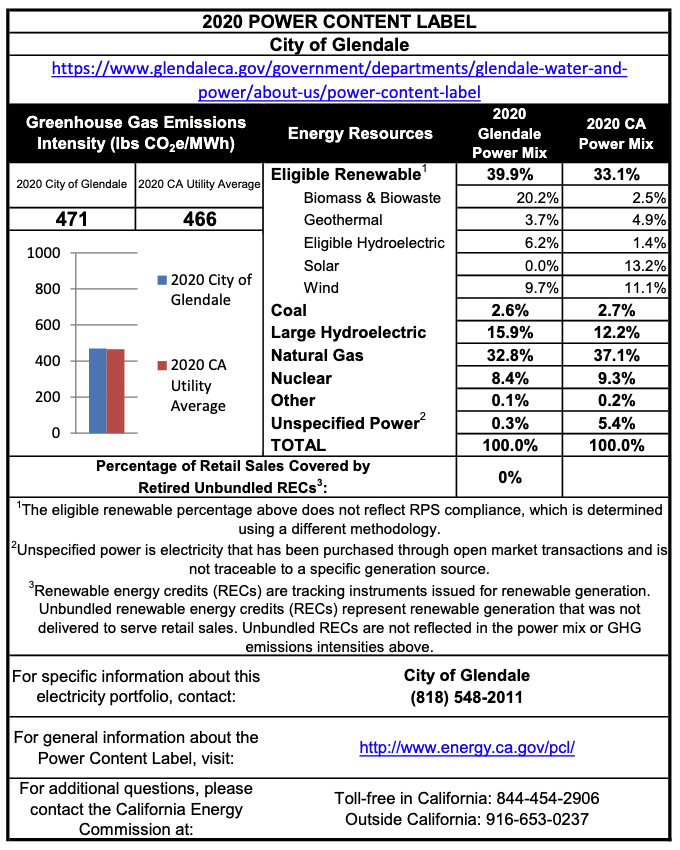
2020 Power Content Label
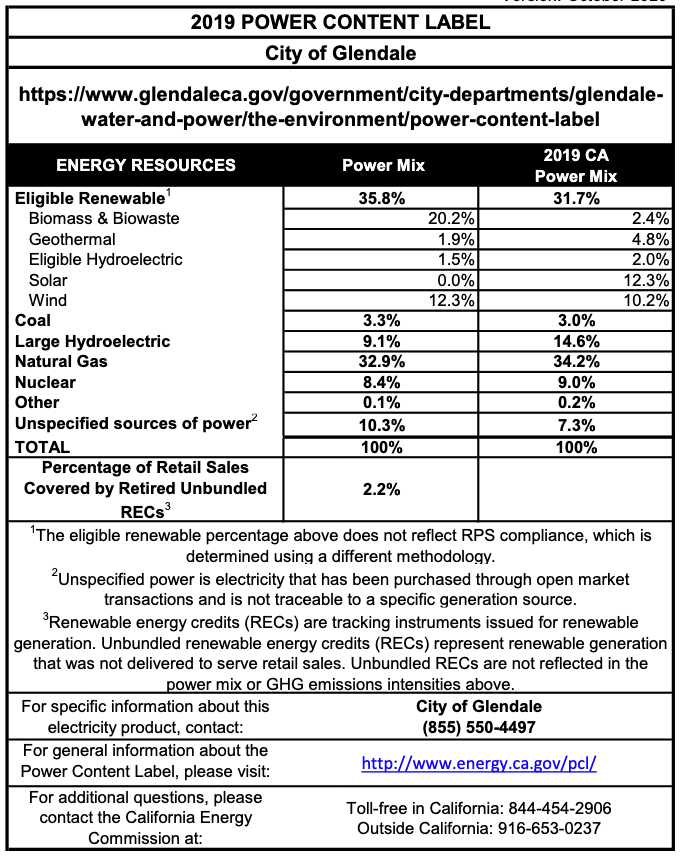
2019 Power Content Label
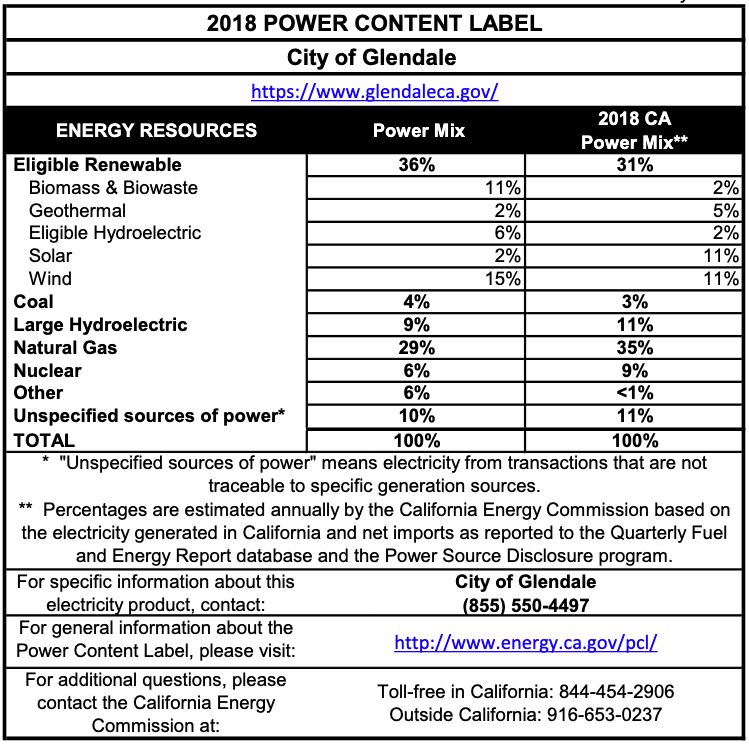
2018 Power Content Label
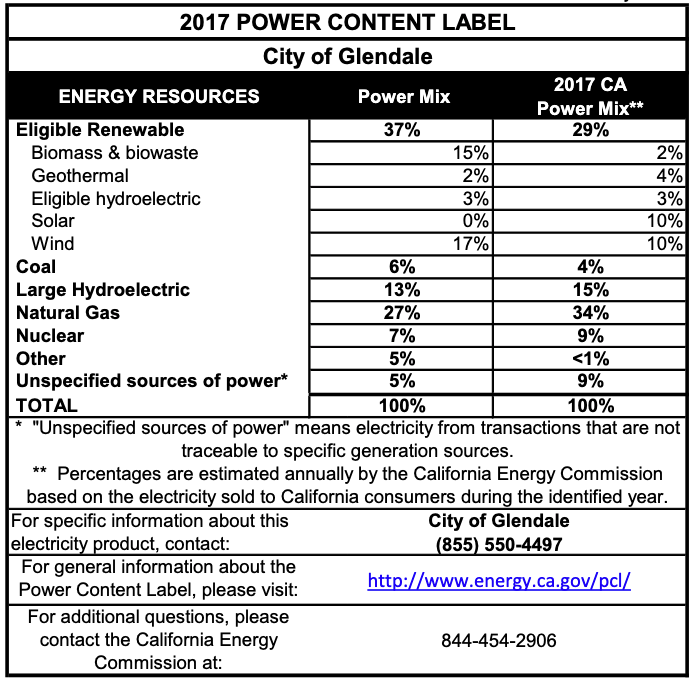
2017 Power Content Label
2016 Power Content Label
Additional new solar on the way from Milford Solar Project Phase II (Utah)
GWP recently signed a 30-year Power Sales Agreement (PSA) with Southern California Public Power Authority (SCPPA) for the purchase of 25 MW of renewable solar energy from the utility scale, Milford Solar Phase II Project, in Beaver County, Utah. Pricing is set at a 30-year fixed price of $37.75 per megawatt hour (MWh) with energy being delivered via the Intermountain Power switching station, through existing transmission. LADWP will own 78.34% of shares of the 300 MW contract capacity, while Burbank owns 13.33% and Glendale owns 8.3%. Glendale’s eligible renewables will take an even larger jump after this project comes on line approximately December 31, 2026. Per a recent staff report, the “Millford Solar II is expected to boost solar energy to an estimated 30%, increasing the total renewable energy to an estimated 49%, and overall clean energy to 68%.”
The bigger picture
In addition to the Eland Project and Milford Solar Project boosting our clean energy numbers, the 75 MWh Battery Energy Storage System (BESS) on order for the Grayson site will provide new, local, clean power starting in 2026. The BESS will provide up to 4 hours of peak power daily, from locally generated solar supplemented with procured solar. This is why installing local solar to store in the Grayson BESS is so important. On this front, progress is being made with the first solar-owned pv sites starting to come online, but we still have a lot of work to do. Unlike their gas powered counterparts, pv systems, once built, will provide 25-30 years of “free” power from our abundant Glendale sunshine to our BESS and out to all of us. There are no gas price spikes to worry about, they have little ongoing maintenance costs, and the power they generate is not at risk of being reduced or completely cut off due to long distance transmission issues (from wildfires, over-heating, etc.) This is particularly helpful when the sun is out in full force, during the summer heat waves, and our locally generated solar is able to fill our locally available battery storage once the sun sets and power use is at peak levels. Locally generated, stored solar provides long-term resiliency and cost-effective power, and it helps us to achieve significant greenhouse gas reductions.
We have much more work to do to invest in local clean energy programs, and the pace must quicken, but today we celebrate our progress with the Eland Solar and Battery project and Millford Solar Phase II Project! Kudos GWP.
L.A.’s massive new solar farm is cheap and impressive. More, please
By Sammy Roth, Climate Columnist
Dec. 5, 2024
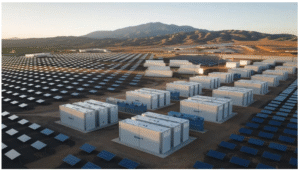
Press Release: Arevon Launches Eland 1 Solar-Storage Plant in California
Dec 10, 2024
Discover more from Glendale Environmental Coalition
Subscribe to get the latest posts sent to your email.