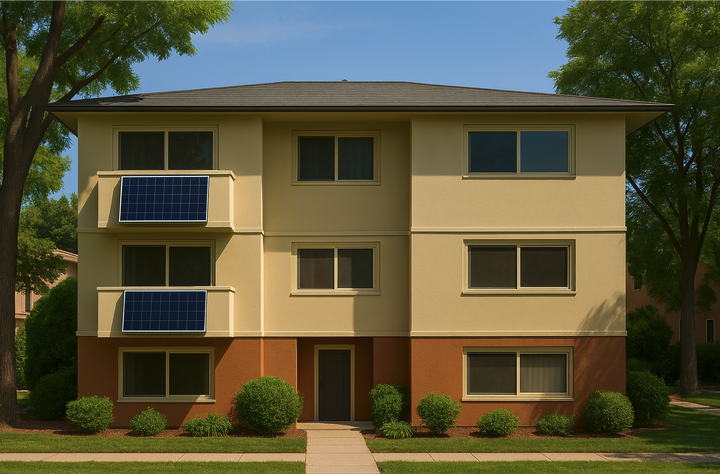
Plug-in “balcony” solar is one of the simplest ways to access solar power today. These are small, modular systems—typically under 1200 watts—that plug directly into a standard outlet and immediately begin offsetting your home’s electricity use.
Instead of a large rooftop installation, these systems can be placed on a balcony, patio, backyard, or along a fence. They work like an appliance in reverse, feeding power into your home and reducing what you pull from the grid. They allow you to immediately begin producing clean energy that will lower your electricity bills.
Balcony solar brings the power of the sun to multi-family residents.
According to a study from the National Renewable Energy Laboratory (NREL), as many as 53 million people in the United States cannot install rooftop solar for reasons such as roof access, ownership, shading, HOA rules, and structural constraints, keeping many on the sidelines. Balcony solar makes solar accessible to a much wider group of people. Renters, condo owners, and anyone without a suitable roof can now participate. The cost is far lower, and systems can be installed in minutes and expanded over time.
There are also resilience benefits. When paired with a battery, plug-in solar can provide backup power and help households maintain essential loads during outages.
From a grid perspective, these systems behave more like demand reduction than large-scale generation. Most of the energy is consumed locally, and any excess is quickly absorbed by nearby homes. Studies suggest this technology has the potential to delay costly grid infrastructure upgrades.
Costs are expected to fall rapidly as adoption grows, following the same trajectory seen in other solar technologies. This positions plug-in solar as one of the most affordable energy solutions in the near future.
Balcony Solar now legal in three states, with legislation advancing in over twenty others.
Balcony solar is already widely adopted in Europe, where as many as 4 million devices are in use in Germany alone. Until now, laws requiring utility permission to install have prevented widespread adoption in the United States, but with new proposed policies nationwide, that tide is shifting dramatically! Washington, D.C. plus 33 states from Alaska to California to New York to Illinois to South Carolina, have announced their own legislation to make these systems permissible without red tape.
Three states—Utah, Maine and Virginia —have signed bills in to law. Maryland and Colorado became the fourth and fifth states to deliver plugin-solar legislation to their respective governors’ desks. Legislation is advancing in eleven additional states and has been introduced in a further eight. All of the bills can be tracked here.
Notably, the Colorado bill takes an important next step for multi-family accessibility: “The bill also prohibits landlords from preventing the installation of a portable solar generation device, but requires tenants to notify the landlords, and allows landlords to set rules for preventing fire and electrical overload of the apartment’s circuits. HOAs are also prohibited from preventing the installation of portable solar devices, as long as the devices are properly attached and secured.” (pv-magazine-usa.com)
With simple, nationally-recognized safety standards and clear labeling, “plug-in” solar can move from novelty to commonplace, especially in communities where traditional rooftop solar isn’t feasible. The kits will be like an appliance you can buy at your local big-box store and set up yourself — on your balcony, in your yard — anywhere the sun shines on your property. Safe, immediate and no red tape!
Support California’s Plug and Play Solar Act, SB 868
In California, legislation like SB 868 (Sen. Wiener, Author, Assm. Nick Schultz, Joint Sponsor) could help accelerate adoption by removing regulatory barriers and enabling safe, standardized deployment of balcony solar. This is a critical step toward expanding access to clean energy.
“SB 868 provides consumers with a straightforward way to take control of their energy bills. The bill ensures that these plug-and-play systems meet strict safety standards. All systems must be certified by UL, or Underwriters Laboratories, the global independent safety science company, or an equivalent national testing lab and automatically shut off within seconds if the grid goes down, protecting utility workers and preventing electrical hazards. System size is capped at 1,200 watts, enough to power everyday appliances like fridges, lights, Wi-Fi routers, or a window AC unit.” (Environmental Working Group, Bill Sponsor)
HOW TO SUPPORT THE CA BILL
If you support making solar more accessible and affordable, contact your CA State Senator or Assemblymember and ask them to support SB 868! The Solar Rights Alliance has easy ways to TAKE ACTION NOW to support the bill. You can also send a comment through this portal directly to the CA legislature as the bill moves through the various committees.
Small actions like this can help bring practical, scalable solutions to millions of people. GEC is a proud supporter of SB 868!
Post Image is for illustration purposes.
Discover more from Glendale Environmental Coalition
Subscribe to get the latest posts sent to your email.