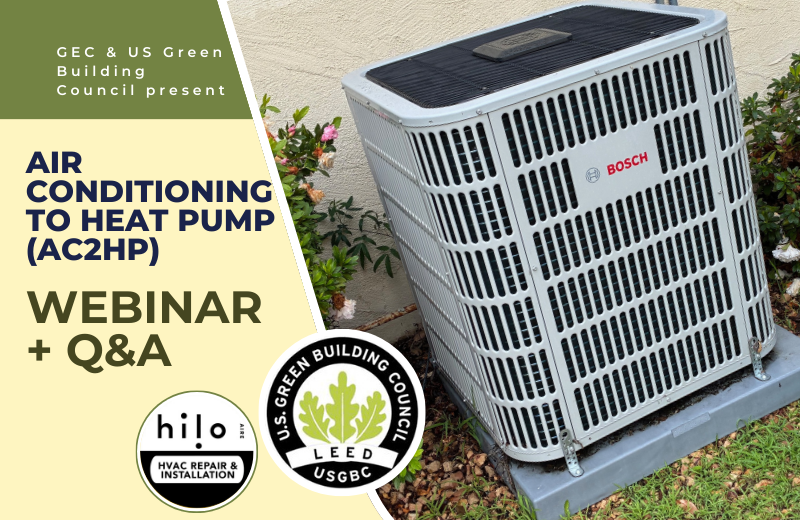
The Glendale Environmental Coalition partnered with guest speakers Michael Rochmes, Policy and Advocacy Coordinator at the U.S. Green Building Council, California (event co-sponsor), and Brett Markey, Co-owner of Hilo Aire, to educate Glendale residents on the city’s newly-passed Air Conditioning to Heat Pump Reach Code. In addition to explaining the new code and heat pump technology in general, our speakers offered real-world technical and installation information, explained the benefits of system efficiency, dual heat/cool function and indoor air quality, shared incentive, rebate, cost savings and savings-over-time information and offered advice on finding a contractor. The end of our webinar is a Q&A. Our experts answered thoughtful questions from attendees, which are transcribed below. We hope you enjoy the webinar and provided resources!
Originally Recorded: December 8, 2025
WEBINAR RECORDING:
OVERVIEW:
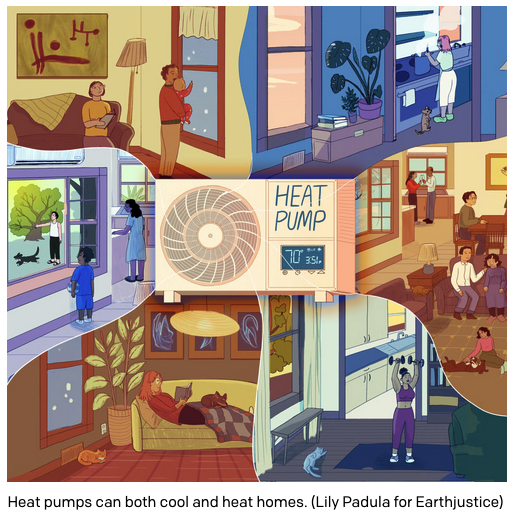
What are Heat Pumps? “Heat pumps give off none of the unhealthy fumes of traditional furnaces — and hold a steady temperature better. Instead of producing heat by burning gas or other fossil fuels, these state-of-the-art magic machines use electricity to move heat from inside or outside buildings, making them two to four times more efficient than traditional combustion technologies like gas furnaces or water heaters. You can think of a heat pump like an air conditioner, but one that also works in reverse. Like your typical A/C unit, heat pumps provide cooling by pulling heat from the air inside your home and moving it outside. But unlike an air conditioner, heat pumps can also warm your home by pulling heat from the air outside into your home. Using this incredible technology, heat pumps can warm and cool our spaces — and, heat our water and dry our clothes. ” (Source: Earth Justice Check out the full post, “Make Your Home Cleaner and Comfier with a Heat Pump” for a great overview!)
Reach Code: The City of Glendale adopted an AC to Heat Pump (AC2HP) Reach Code in Fall, 2025 which, the City’s website explains, applies “to single-family homes, duplexes, and town homes when an existing air conditioning system is replaced, altered, or when a new air conditioning system is installed. Repairs are not affected by the code change. The proposed code would require either: installing a heat pump as the primary heating and cooling system, or installing a new air conditioner along with specific energy-efficiency upgrades, such as duct sealing, insulation, and system performance improvements.”
Exceptions: Per the City, the proposed code would not apply if: (1) an AC system is being repaired rather than replaced, (2) the current electrical panel doesn’t have enough capacity to power a heat pump that’s large enough to properly meet the heating load, (3) the heat pump required would be significantly oversized (more than 12,000 Btu/h larger than the existing system). Also, there are also exceptions to the duct sealing and airflow requirements that specify alternative methods of compliance. All applicable exceptions in the California Energy Code apply.
WEBINAR NOTES:
- If you would need a panel upgrade to install a heat pump, but not a new AC, you get an exception; however, this rarely happens because heat pumps use a similar amount of electricity as AC units.
- For AC, if efficiency is the same, electricity cost will be the same. If replacing an old electric heating unit, the cost to run will be lower.
- If replacing a gas furnace with a heat pump, running in winter, at this moment the cost might be a bit more to run the first year, but gas prices are expected to rise and therefore the heat pump unit will be cheaper to run in the future.
- Heat pump must be energy-star rated.
- GWP Incentive is $1,000 per ton (up to five tons.) Note: Additional incentives listed below.
- Can stack incentives (see SCAQMD Incentive and Clean Tech Incentive below)
- Some of the incentive programs will require you to de-activate your gas furnace and/or cap the gas line at the HVAC unit.
- Glendale is the first city in LA County to have an AC2HP ordinance but 10+ other CA cities have passed AC2HP Reach Codes.
- Contact: michael@usgbc-ca.org to find out how to get involved if you would like to bring this code to your city (if not from Glendale):
- Heat pumps are the focus across the nation. Heavy focus on developing products to be even more efficient and issue-free.
- May need to upgrade to 220 for the heat handler part. Very low likelihood of having to upgrade panel.
- The cost difference between straight AC and heat pump HVAC is small – maybe $300-$1000 more for equipment plus cost of electrical changes. Not a large difference. (GEC NOTE: Incentives decrease or eliminate any difference. See below for information and links.)
- If you were replacing gas HVAC system today, code requires ultra low nioxide emitting furnaces. These are very finicky systems that often require repeat service visits to fine tune.
- You will see a little bit less efficiency if you keep your central furnace – the indoor/outdoor system package will be the most efficient system.
- Energy bill costs will be 65-70% more efficient in your summer usage. That balances out the higher winter heating cost. Brett’s customers are seeing an overall annual savings.
- If you have a backup gas unit, it can only be used as backup.
- New SCAQMD rebates are available now: https://www.aqmd.gov/go-zero
Q&A CLIFF NOTES:
Q. Is it true that older homes with poor/less insulation and lots of leaks have poor results?
A. Yes, no matter what kind of AC unit or HVAC system you are replacing, if you have poor insulation it will work less efficiently.
Q. Is it better to replace a system pre-emptively vs. when the system breaks?
A. It’s up to the home owner, but never a bad idea. When your system breaks down, it’s probably going to be 110 degrees outside and you will have to wait longer for a good contractor as they will be very busy. Being proactive allows you to avoid this and also take advantage of the new rebates.
Q. How long does AC system last?
A. In our climate, they can last 15-20 years. The gas co says 12 years is when the heat exchangers can begin to have fissures that can cause carbon monoxide leaks. If you notice that you are needing annual service, it’s probably time to think about replacing the system. With various rising costs, every month you wait means the system is a little bit more expensive. Good to take advantage of the rebates and avoid having to avoid wait times.
Q. Does the Glendale policy apply to mini-splits?
A. The policy only applies for centralized systems, but incentives still apply. Mini-splits are for one room (a garage or a specific room in your house) but now, more people are starting to use them in the house in several rooms. It’s useful to have full zoning, to control the temperature of each room. The cost to replace a central system with a bunch of mini-splits will be a lot more expensive, but that money will come back to you over time with reduced costs by being able to only use them to heat/cool only the rooms you are using.
Q. Will people have to replace their HVAC ducts?
A. No, not if your ducting was sized correctly for the system that you are replacing and the condition of the ducting is still good.
Q. What is the heat pump permitting process like in Glendale?
A. Exactly the same as replacing an AC system. It’s simply a mechanical permit. You would not need permission to have the system again. It’s a quick application that the contractor gets back within minutes. An inspector comes out at completion.
A. Getting the permit is an extra step, but it gives the homeowner peace of mind to know that the contractor is doing things correctly – that small details are being taken care of properly, ensuring your system will last for 20+ years.
A. It’s also not a lot of money…maybe a few hundred dollars.
Q. If my central AC was not permitted, will I need a permit now?
A. Most homes have original furnaces, and they were permitted with the building of the house. So the change in adding a heat pump will be minimal and no difference than replacing an AC system.
Q. Are heat pumps noisier than AC units?
A. 95% of the time, no. The indoor blower motors have gotten much quieter and more efficient. For the outdoor part, in cooling mode, there is no difference from standard AC and heat pump. Outside in winter, the heating will have some noise now that you would not have had before.
Q. We hear that refrigerants are changing. Are the new ones as good?
A. They are not better/worse, just more environmentally friendly…a different chemical makeup. The new refrigerants are being used for all tech – both heat pump and AC.
Q. What are the upfront installation costs?
A. This is not possible to estimate, because each home is different (Please see video for a bit more on this.)
Q. What is the annual cost difference to run a heat pump system versus a traditional system?
A. As part of the reach code process, the City was required to do a cost efficiency study, estimating utility bill costs over an entire year. They gave examples of a range of scenarios that showed either about a $100 extra or $50 less annual cost. (Note too that gas prices are expected to rise in the future.)
Q. Are CA Clean Tech funds depleted?
A. December 2025 Response: Funds are back! Money comes in blocks. Was gone for 1.5 months, but money has been re-upped. Brett thinks that funding will be there consistently. Michael mentioned that when the funding is there, the contractor reserves it for you. This way you know you can count on it. (Note, Feb 2026 – this incentive is currently depleted again. Check back!)
Q. Is the CA Clean tech incentive retroactive? (Can you get it if system is already installed?)
A. No
Q. How can you make sure you size your system correctly?
A. On average systems are sized at approximately one ton per 400-500 sq feet, but the contractor should be doing a manual load calculation on your home. This considers several factors such as the size of the home, insulation levels, which way it’s facing, etc. In CA, they want the contractor to factor in the average summer temperature (which in our area is 94 degrees) – but if it’s 105 degrees, your system might be undersized for you. You look for CFM (volume of air you need for the house). If you want it at 68 degrees you would have a larger system than someone who wants their home at 80 degrees, so systems are designed on an individual basis. (See note below however on variable speed systems)
Q. What do you think of variable speed systems?
A. They are preferred and most often installed. This allows you to install a larger ton system but not use it at the full capacity (can use it at lower capacity but then have it run at full capacity ONLY when needed. ) In future, this will be the standard.
Q. Where is a heat pump system installed and does it have a bigger footprint?
A. The equipment inside of house is the same size. The outside condensers have gotten larger for both traditional and heat pumps systems as radiator coils have gotten larger to meet higher efficiency code standards; however, heat pump condensers are now replicating mini split technology (discharging from the side vs top) and thus are now taller but skinnier and are very quiet. So quiet you would have to walk up on them to know if it’s on or not.
Q. Are there any current precautions regarding the refrigerant?
A. No. They are all safe for day-to-day use. What is better now is the green house gas impact from leaks that can happen during disposal. The older refrigerants are REALLY bad for climate. The new ones are still bad, but less bad.
Q. Does GWP require you to cap the gas line to qualify for the incentive? Can you keep the gas line used for other appliances?
A. Yes and yes. To get the incentive, you must cap the line at the furnace, which is at the end of the gas line. This would not affect anything else in your house. You would still be able to use other gas appliances you have installed (eg range, water heater.)
Q. How do you make sure all equipment meets the required local codes?
A. Check the AHRI rating. All systems use the same AHRI rating system, provided by the Air-Conditioning, Heating, and Refrigeration Institute (AHRI) after third-party testing, to demonstrate they meet established efficiency standards.
Q. When installing a mini-split, how do you dispose of the old duct work safely and economically?
A. Bag up and remove or cut up and bag out. It is recommended to remove ducting that has asbestos wrap. Helps the building envelope. If not tampered with much, the average removal cost is about $1,000.
Q. Keeping a gas pump for supplemental heat was mentioned several times. Does that mean that a heat pump won’t be adequate to heat my home?
A. No. The lower the temperature outside, the less latent heat there is to bring into your home, but the tech is getting better and better, with improvements for colder temperatures even over just the past two years. A dead short electrical can be added inside the unit for extremely cold days. If you keep an old gas system, it would only come on if the temp comes down below the system’s limits. Here in CA though, the supplemental isn’t really needed. In very cold areas, like Northern Europe, they have cold climate heat pumps [GEC note: Cold climate air source heat pumps operate efficiently down to -15°F or -20°F]
Heat Pump Tip: Keep the house a little more temperate at night so the unit doesn’t have to work so hard to heat or cool in the day.
Q. Will the new ordinance affect the cost and lead time if your system needs replacing during a heat wave?
A. It would not (per contractor, Brett Markey, HIlo Aire). If there is a lack of equipment, it would be across the board, not just for heat pumps. They are being well-stocked.
Q. Where does the money for rebates come from? Will the ordinance still be enforced if that money runs out?
A. The rebates come from the Public Benefits Charge funds. About half goes to bill rebates for low-income residents and some of the funds go to the incentive programs. This is an ongoing funding source. GWP is confident there will be funding for this. There is no provision that the ordinance stop if the rebate funding goes away. City Council can always change the policy if they wish, but there is no automatic trigger to stop enforcement.
Q. Is it hard to find an installer?
A. The difference between installing AC vs. heat pump systems is negligible. Most contractors could install either, but do your due diligence and make sure they ask the right questions and stand behind warranties.
Q. If you currently use plug-in heaters and aren’t using a whole house system, can you still get an incentive to install a heat pump system?
A. Yes, you can still get incentives, as long as you cap the gas line at the old unit.
Q. What is the best manufacturer or system that you would recommend to your best friend or mom?
A. (Per Brett Markey, Hilo Aire) Lennox, manufactured in USA. Great warranty. Have all the equipment bells and whistles. Excellent support. Lennox Variable Speed is what he has in his house.
Contacts: brett@hiloaire.com; michael@usgbc-ca.org
HEAT PUMP HVAC INCENTIVES
Note: Can stack incentives, though for the SCAQMD rebate, terms state: “Rebate issued to each applicant, in combination with other incentives approved for the installation, shall not exceed the total project cost.”
Note: Some of the incentive programs will require you to de-activate your gas furnace and/or cap the gas line at the HVAC system.
 SCAQMD REBATE: “Go Zero” Space and Water Heater Incentive Program for single family, multi family and small businesses – while funds last (at time of this posting, the funding seems to be paused, but not depleted.) Information on ALL programs here. Single family info: $1500 rebate for heat pump replacing gas or propane HVAC systems. If you live in a pollution “overburdened” area of Glendale (eg South Glendale or in the Rancho or parts of Pelanconi near Grayson) the rebate is $3,000. Check your address here. PROGRAM INFO / SINGLE FAMILY APPLICATION PORTAL / APPLICATION INSTRUCTIONS / APPLICATION FORM (Note: SCAQMD also offers a $1,000 rebate to replace a gas/propane powered water heater with an heat pump water heater.) As noted above, customers can stack rebates, but not to exceed the total project cost. Info: GOZEROapply@energycoalition.org
GWP REBATE: Glendale Water and Power ENERGY STAR® Heat Pump/Mini-Split Heat Pump (Replacing existing Heat Pump)- $500 per ton ($2,500 max)
GWP REBATE: Glendale Water and Power ENERGY STAR® Heat Pump/Mini-Split Heat Pump (Replacing an existing gas and electric HVAC system or gas furnace with an all electric Energy Star Heat Pump technology) – $1,000/ton ($5,000 max) Issued as a check. Must cap gas line at the unit.
Funding Currently Depleted – TECH Clean CA: Single Family Heat Pump HVAC and Heat Pump Water Heater Incentives (restrictions apply) – Note: Funding for SoCal incentives has been fully reserved as of February, 2026 but check back as they re-up funding often.
Pre-2026 Installs Only – IRS: Energy Efficient Home Improvement Credit – The credit is allowed for qualifying property placed in service on or after Jan. 1, 2023, and before December 31, 2025. Program does not apply to improvements made in 2026.
RELATED ARTICLE:
 Why We Should All AC2HP ASAP
The Year-Round Comfort Upgrade that Will Keep Cities Leading on Climate
August 13, 2025 by Matt Vespa, Senior Attorney, Earth Justice
Article Excerpt (READ FULL ARTICLE HERE):
“Every air conditioning-only installation is a missed opportunity to cut pollution.
Because heat pumps are essentially A/C units with a two-way valve to provide both heating and cooling, single family homes with an existing central A/C unit can simply swap their air conditioning unit out with a heat pump and gain a clean source of heating. (Read about how heat pumps work.)
This makes AC2HP an effective and low-cost climate strategy. Whereas replacing a gas furnace with a heat pump might involve electric upgrades and other costs, the wiring, electric capacity, and space to install a heat pump is already in place when installing a heat pump at the time of A/C replacement.
This single step would go a long way to helping local governments achieve their climate targets and improve air quality: if all central A/C units sold were heat pumps, California could electrify space heating in over half of homes by 2030.
On top of their climate and air quality benefits, heat pumps also create a more comfortable home by maintaining a consistent temperature. Because the average heat pump is more efficient than the average A/C unit, they also bolster grid resilience by reducing electric demand on hot summer days. And by no longer relying on a gas furnace, households don’t have to replace it when it breaks. Households that install a central A/C system now, just to have their furnace burn out a few years down the line, could end up paying for two systems when they could just pay for one.”
FIND CONTRACTORS:
HIRING A CONTRACTOR:
RELATED VIDEOS:
Discover more from Glendale Environmental Coalition
Subscribe to get the latest posts sent to your email.